Fake Buffalo Couriers pages ask for your ID and card details to pay a delivery fee
Who may be targeted: People who receive a Buffalo Couriers delivery or payment link, especially messages asking for a small delivery fee.
What we are seeing
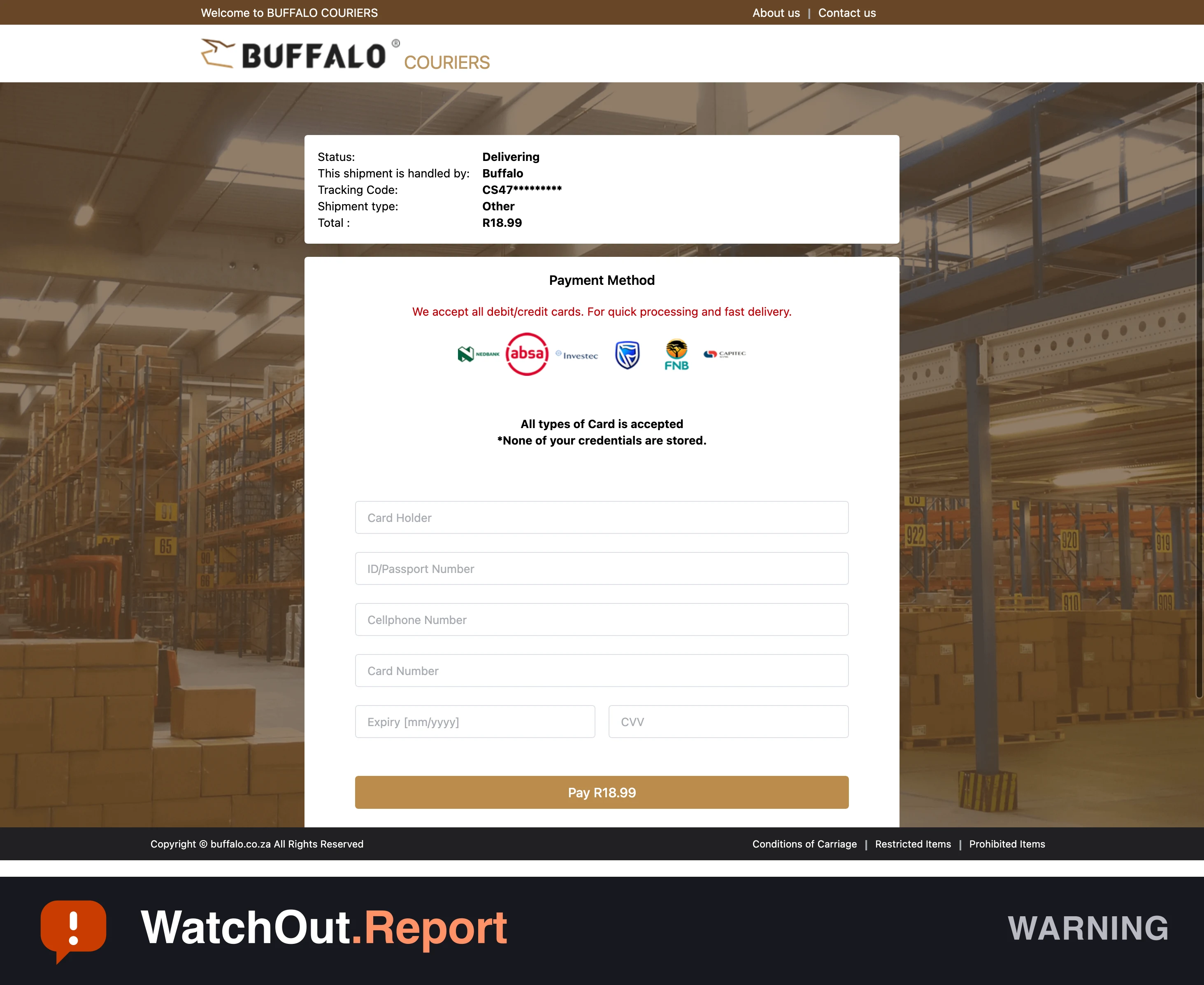
A Buffalo Couriers-branded page shows a fake shipment summary and says an R18.99 shipping fee must be confirmed within 48 hours. A confirmation button leads to a second page that requests an ID or passport number, cellphone number, card number, expiry date, and CVV. The pages are hosted on an unrelated address, and the second page's code sends submitted information to an unknown Telegram recipient. Do not enter details or pay through the pages; check deliveries through the courier's official website or app opened independently.
Warning signs
- The payment page is hosted on an address that does not belong to the courier.
- A small R18.99 delivery fee and a 48-hour deadline are used to make the payment request seem harmless and urgent.
- A fake tracking code and shipment summary are used to make the page look like a real delivery portal.
- The page asks for an ID or passport number as well as the full card number, expiry date, and CVV.
- The page claims that card details are not stored, but its code sends the submitted information to an unknown Telegram recipient.
- A confirmation button leads from the shipment page to a separate card-collection page.
- The page uses courier logos and warehouse images but does not provide a normal official tracking route.
Reported addresses
Written so they cannot be clicked. Do not retype them into your browser.
f006[.]backblazeb2[.]combuffalo[.]co[.]za
Source and limitations — what this alert does not establish
- The downloaded page shows how submitted data is sent to a Telegram bot, but it does not establish who controls that bot or how many people submitted information.
Published Sep 8, 2026. Published by the Cybersecurity Reach Foundation.
Send this to someone it could protect.