Do not accept a crypto payment based on a screenshot or fake explorer link
Who may be targeted: Anyone accepting cryptocurrency for goods, services, loans, investments, or other payments, especially people relying on screenshots or links supplied by another person.
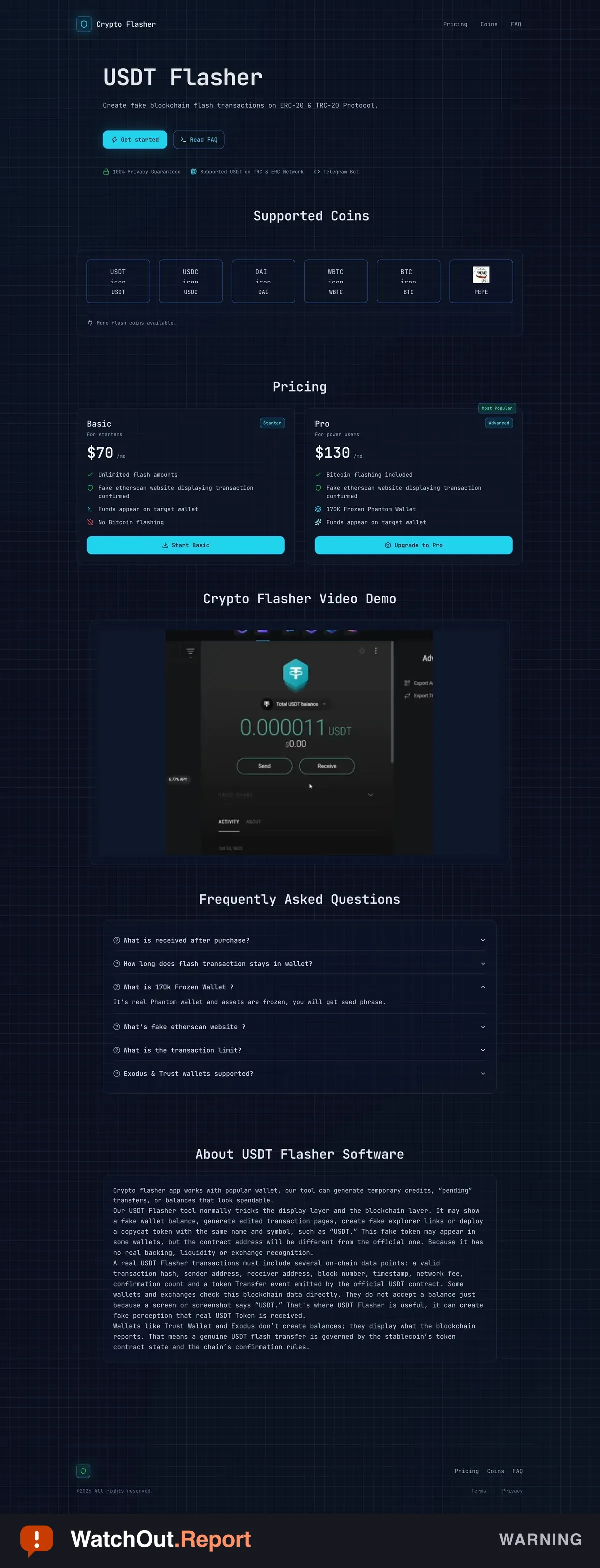
What we are seeing
A website at cryptoflasher[.]net advertises a paid tool that claims to create temporary crypto credits, pending transfers, fake wallet balances, and fake blockchain-explorer pages showing a transaction as confirmed. A person could use that false proof to persuade someone to release goods, money, or services before a real payment exists. Verify every crypto payment independently on the correct blockchain before accepting it.
Warning signs
- A website openly promises fake or temporary blockchain transactions.
- It advertises fake wallet balances or explorer pages that show a transaction as confirmed.
- It says a flash transaction may fail or disappear after a few days.
- The payment is shown only in a screenshot, supplied link, or someone else's wallet display instead of your own verified account.
- The coin name or symbol appears familiar, but the official token contract and blockchain record have not been checked.
Reported addresses
Written so they cannot be clicked. Do not retype them into your browser.
cryptoflasher[.]nethai8g[.]com
Source and limitations — what this alert does not establish
- The observed website advertises these capabilities, but the site alone does not establish that every feature works, identify its operator, or prove a specific victim loss.
- A screenshot or supplied explorer link is not proof of a real payment. Confirm the transaction independently on the relevant network.
First observed Sep 11, 2026. Published Sep 11, 2026. Published by the Cybersecurity Reach Foundation.
Send this to someone it could protect.